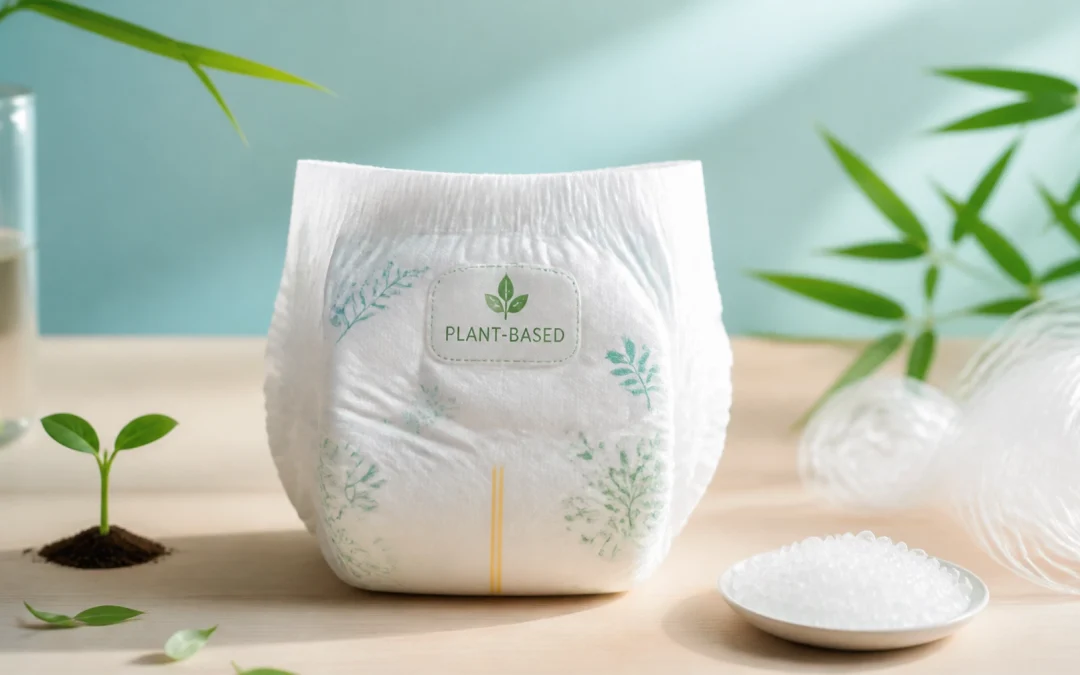
Hey there, fellow parent! If you’ve spent any amount of time in the baby aisle lately (usually while balancing a sleeping infant and a venti coffee), you’ve probably seen them. You know the ones, the diapers with the soft green leaves, the earthy Kraft-paper packaging, and those big, bold letters shouting "PLANT-BASED!"
It feels like a total win, right? You’re doing something good for your itty bitty baby and the planet. But then, that little voice in your head, the one that keeps you up at 3 AM wondering if you’re doing any of this parenting stuff right, starts asking questions. How can a disposable diaper be made of plants and still hold that much liquid? Is it really as "eco" as it looks?
Well, grab your coffee (or your tea, we don't judge!), because today is Day 3 of Education Week at Luludew, and we are diving deep into the "Plant-Based" myth. We’re pulling back the curtain on what those labels actually mean, why the "75% plastic" secret is a thing, and how new laws in California are finally starting to fight for the transparency we deserve!
The "75% Plastic" Secret: What's Actually in the Box?
Let's get real for a second. When we see "plant-based," we usually imagine a diaper made of corn husks, bamboo, and pure sunshine. We picture something that could basically disappear into the garden in a few weeks.
Here is the "heck" moment: Most "plant-based" disposable diapers are still mostly plastic.
Wait, what?! It’s true! Even when a brand markets itself as eco-friendly, industry data shows that a typical disposable diaper is often 60% to 80% plastic by weight.
So, where does the "plant-based" part come in? Usually, it’s just the top sheet (the part touching the baby's skin) or a portion of the back sheet that is made from plant-derived materials like sugarcane-based polyethylene or bamboo fibers. While that's a step in the right direction, the rest of the diaper, the leg cuffs, the fasteners, the elastics, and the adhesives, is still very much made of traditional, petroleum-based plastic.
Pro-tip: If a label says "made with plant-based materials," it’s often a marketing way of saying "contains some plants, but don't look too closely at the rest!"

SAP: The "Magic" Plastic Gel
Have you ever wondered how a diaper thinner than a pancake can absorb three heavy wet-downs without a single leak? That’s thanks to SAP, or Super Absorbent Polymer.
SAP is that little gel-like material (sodium polyacrylate) that lives inside the core of the diaper. While it’s incredibly effective at keeping your baby’s bum dry, it is not a natural or plant-based material. It’s a synthetic polymer derived from petrochemicals.
In a modern disposable diaper, SAP can make up about 15% to 25% of the total weight. Even the most "eco" disposables on the market almost always use conventional SAP. Unless a brand explicitly states they are "SAP-free" (which is rare, because those diapers are much bulkier!), you are essentially wrapping your baby in a core of plastic gel.
California's Big Move: The Diaper Transparency Act (AB 1901)
If you’re feeling a bit of that "parent guilt" right now, please take a deep breath and let it out. You aren't doing anything wrong! The problem isn't your choices; it’s the lack of information available to us.
Thankfully, here in California, we are leading the charge for change! Assembly Bill 1901, also known as the Diaper Transparency Act, is a massive win for parents everywhere. This law is going to force diaper manufacturers to finally show their cards.
Under AB 1901, brands sold in California will have to:
- Disclose every intentionally added ingredient on their website (by 2028) and on their packaging (by 2029).
- List the Chemical Name and the CAS number for every ingredient. No more hiding behind vague terms like "fragrance" or "absorbent core."
- Explain the function or purpose of each ingredient.
While this law doesn't force brands to state the exact percentage of plastic (yet!), it makes it much harder for them to hide behind leafy-green marketing. Soon, we’ll be able to see exactly which plastics, adhesives, and chemicals are going into the products we use on our babies every single day.

Why This Matters for Your Movement
At Luludew, we believe that parenting is a shared journey, a movement toward a more mindful, intentional way of living. We know you want the best for your baby, and we also know you're busy! How are you supposed to research CAS numbers while also trying to figure out why the toddler is currently wearing a colander as a hat?
This is why we focus so heavily on education. We want to bridge the gap between the "eco-hype" and the heart of the matter. When brands use "plant-based" as a buzzword, it dilutes the efforts of families who are truly trying to make a difference.
Who doesn’t need a break from the confusion? That’s where we come in! We’ve spent years perfecting a system that takes the guesswork out of sustainability. Whether you’re looking for a Weekly Diaper Delivery Service in Los Angeles or our Fresh and Simple Cloth Rental nationwide, we provide a solution that is actually plant-based.
Breaking the Myth with Real Solutions
If "plant-based" disposables are still 75% plastic, what’s the alternative? You guessed it, good old-fashioned cloth!
Our organic cotton prefolds and reusable covers aren't just "plant-based" in name; they are the real deal. When you choose cloth, you are opting out of the plastic-cycle entirely. You’re choosing breathable, natural fibers that are better for your baby's skin and significantly better for our planet.

"But Penny, I don't have time for all that laundry!"
We hear you! The chaotic side of parenting is real. Between the blowouts, the nap strikes, and the mountain of laundry that already exists, adding diapers to the mix can feel like a lot.
Pro-tip: You don't have to do it all yourself!
- The Full Service: If you're in SoCal, our delivery service handles everything. We pick up the dirty ones, professionally wash them, and deliver fresh ones to your door. Zero laundry for you. Zero plastic for the planet.
- The Mini-Course: Not sure where to start? Check out our Start with Peace of Mind Mini-Course. It’s a series of bite-sized videos designed to give you the confidence to start your cloth journey.
You’ve Got This!
At the end of the day, the "Plant-Based" label is often just a mask for the same old plastic products. But now that you know the truth, you have the power to make a choice that aligns with your values.
Whether you decide to go full cloth or just swap out a few diapers a day, every single choice matters. You are part of a movement of parents who are saying "no" to the myth and "yes" to a cleaner, more transparent future for our babies.
How did we get here? By asking questions! By caring! And by supporting each other in this wild ride called parenthood.
Stay tuned for more Education Week tips, and remember: you're doing a great job!

Want to learn more about our journey? Read About Luludew and join the movement today!