You’re pregnant. You’ve taken the test approximately 400 times. You’ve opened a few tabs about birth plans, a few more about baby sleep, and somehow you’re now comparing diaper absorbency at 1:17 a.m.
How did we get here?!
Take a deep breath. You do not need to decide every detail of life with your baby tonight. You don’t need a perfect diaper plan, a perfectly organized home, or a spreadsheet with color-coded columns for newborn poop.
You just need a calmer way to research.
If you’re in the Google-spiral stage of pregnancy, welcome! This is where you gather information, notice what matters to you, and begin finding the people who can support you. Cloth diapers are one option worth knowing about, not because you need to commit today, but because you deserve to see the whole picture before the marketing machine starts shouting.
Let’s sort through cloth diapering for beginners and the big question: cloth diapers vs disposables.
First: You are not behind!
The internet can make every baby decision feel urgent.
One article says you need to choose a diaper system before your baby arrives. Another says you need a specific detergent. Someone on a parenting forum has tested 19 brands and created a 42-page wash routine.
Meanwhile, you’re growing an entire human.
Research is supposed to help you feel informed, not make you feel like you’ve failed before the baby is even here.
There is no prize for deciding earliest. There is no parenting gold star for choosing the most complicated option. Your goal right now is simply to understand the trade-offs and notice what feels aligned with your family.
1. Start with your priorities, not product features
Before you compare snaps, liners, fibers, or absorbency ratings, ask a few bigger questions:
- What matters most to our family: reducing trash, saving money, convenience, or a combination?
- Do we want to wash at home, use a diaper service, or keep our options open?
- What would feel manageable during the newborn stage?
- Will we have regular access to laundry?
- Do we want to use one diapering option all the time, or create a flexible mix?
These questions will take you much farther than searching “best diaper for every situation.” Spoiler alert: that diaper does not exist. The perfect diaper is mostly a mythical creature, like a baby who naps exactly when you need one.
And even if you have strong environmental goals, it helps to keep the full picture in view. The American Academy of Pediatrics explains that both cloth and disposable diapers have environmental impacts. Disposables use more raw materials and create more solid waste, while cloth diapers require water, energy, and detergent for laundering. The overall impact depends on how diapers are made, washed, dried, and used.
The most sustainable choice is often the one you can use consistently and realistically.
2. Cloth diapers vs disposables: the calm version
Let’s make this much less dramatic than the internet tends to make it.
| If you’re prioritizing… | Cloth diapers may offer… | Disposable diapers may offer… |
|---|---|---|
| Less landfill waste | Reuse across many diaper changes | Simple disposal after each use |
| Convenience | Flexible systems and service options | No washing or drying at home |
| Budget | Potential long-term savings | Lower upfront commitment |
| Laundry | A routine you can control, or outsource | No diaper laundry |
| Flexibility | The option to use cloth part-time | Easy use for travel, overnight, or backup |
| Skin care | More frequent changes can be straightforward | High absorbency between changes |
Neither option is automatically “good” or “bad.” Neither choice says anything about how much you love your baby or how committed you are to the planet.
Cloth can reduce the number of disposable diapers sent to landfills. Disposables can be easier during travel, illness, overnight stretches, or those days when everyone is crying, including you. A hybrid approach can make sense, too.
You might use cloth at home and disposables while traveling. You might use a cloth diaper service but keep a few disposables for backup. You might start with one option and change your mind.
Flexibility is not failure. It’s a parenting skill.
For a pediatric perspective on the trade-offs, HealthyChildren.org’s guide to disposable and cloth diapers is a helpful place to begin.

3. What cloth diapering for beginners actually involves
Cloth diapering can sound like a whole new language at first.
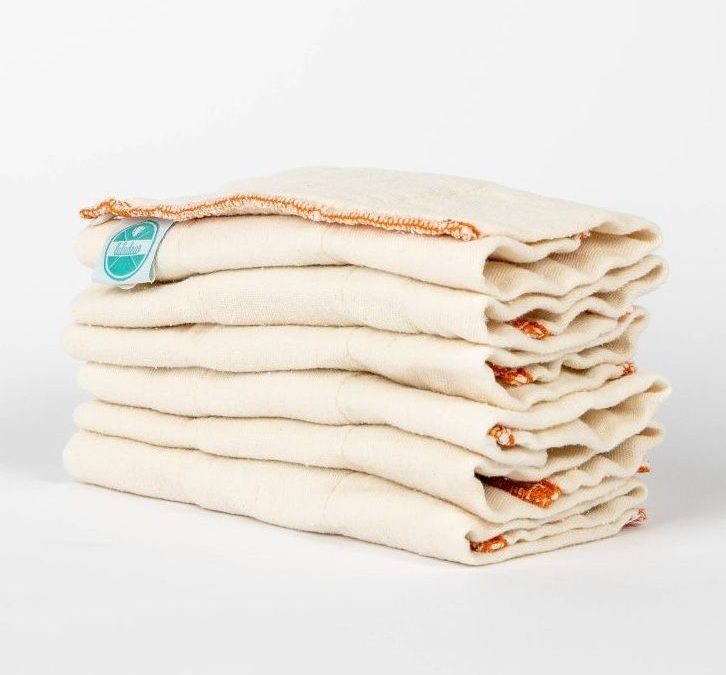
Prefolds. Covers. All-in-ones. Fitted diapers. Liners. Wet bags. Wash routines.
Heck, you’re allowed to read that list and immediately need a snack.
The basics are simpler than the internet makes them seem:
- A cloth diaper absorbs moisture.
- A cover helps contain it.
- You change the diaper regularly.
- Used diapers are stored safely until washing or pickup.
- The system gets adjusted as your baby grows.
That’s the foundation. You do not need to understand every style before you can make an informed decision.
Many families begin with a small, simple diaper set rather than trying to prepare for every possible stage. Starting small lets you notice what works for your baby, your laundry setup, and your energy level.
You can also ask about cloth diaper services. A service may provide clean diapers, pick up used ones, professionally launder them, and bring fresh ones back. That changes the question from “Can I handle all this laundry?” to “Would a supported diapering routine fit our family?”
That is a much kinder question.
4. Don’t let fear-based claims make your decision
When you search diapers, you’ll find some very confident claims:
- Cloth diapers always prevent rashes.
- Disposable diapers are dangerous.
- One type is always better for the environment.
- A particular diaper system will solve every leak forever.
Pause when an article sounds absolutely certain.
Diaper rash is influenced by moisture, how often a diaper is changed, skin sensitivity, fit, and possible reactions to detergents, fragrances, or wipes. No diaper type guarantees perfect skin.
Environmental impact is also more nuanced than a simple “cloth good, disposable bad” slogan. Laundry habits matter. Manufacturing matters. Energy and water sources matter. How long a diaper is used matters.
Green America’s discussion of cloth and disposable diaper impacts offers additional background, while your child’s health care provider can help with specific questions about skin sensitivity, rashes, and newborn care.
A trustworthy source will acknowledge trade-offs instead of trying to scare you into a purchase.
5. Use a three-source research limit
Here’s your permission slip to close 44 tabs.
Pick three types of sources:
One health source
Look for a pediatric organization, children’s hospital, or health care professional. Use this source for questions about rashes, newborn changes, fit, and skin.
One environmental source
Look for a source that discusses the full life cycle of a product, not just manufacturing or landfill waste. You’re looking for nuance, not a dramatic headline.
One real-life source
This might be a local diaper service, a trusted friend, a doula, a midwife, or a parent who has actually used cloth. Ask what their routine looked like on an ordinary Tuesday, not just what worked during their most organized week of the year.
Then stop researching for a little while.
Seriously.
The goal is informed enough to take the next step, not perfectly informed about every diaper ever made.

6. Try a “maybe” plan
You don’t have to make a forever decision during pregnancy. Try writing down a flexible starting plan:
“We’re interested in cloth. We’ll learn more, start simply, and adjust based on our baby and our energy.”
Or:
“We’ll use cloth when it feels manageable and keep another option available for travel, overnight, or backup.”
Or:
“We’re not ready to decide yet, and that’s okay.”
This is a plan. A very good one!
If cloth appeals to you because you want to reduce waste, slow down, or create more mindful daily rhythms with your baby, that matters. For many parents, cloth becomes less about buying the “right” product and more about building a repeatable care routine: one diaper change, one wash, one little wrap at a time.
And if the laundry part feels like a hard no? That matters, too. A service model may help you explore cloth without taking on every task yourself.
A gentle next step with Luludew
If you’d like a little guidance without adding more noise, Luludew’s Start with Peace of Mind video resources are designed to help families approach cloth diapering with more confidence.
For families in Los Angeles, the Luludew diaper service offers weekly pickup, professional washing, and fresh diaper delivery. And for families elsewhere in the country, Luludew’s Fresh & Simple cloth rental provides diapers and wipes, wash guidance, and free size swaps as your baby grows.
You don’t need to choose today. You can simply keep these options in your back pocket while you learn what kind of support would feel good.

The decision you can make right now
You can decide to stop treating diaper research like an emergency.
You can choose curiosity over pressure. You can ask better questions. You can learn about cloth without promising to use it every day. You can choose disposables without giving up on sustainable living. You can try a combination. You can change course.
The win is not picking the “perfect” diaper. The win is choosing a thoughtful starting point that respects your baby, your values, and your actual life.
And once you’ve taken that breath, the next step is not another shopping list.
It’s finding your village.
In the next stop in the From Bump to Cloth series, we’ll talk about building support with a doula, midwife, doctor, or other care provider, because you were never meant to figure out pregnancy or parenting alone.